Showing posts with label free teaching ideas. Show all posts

Tuesday, November 17, 2015

Grateful for Great Educators, and Great Freebies!

Marybeth at Brain Waves Instruction and Literary Sherri have done it again! 


DONE WHAT, you say? 


Why, gathered together an entire "near battalion"  of amazing, passionate, gifted and enthusiastic educators for your benefit, just in time for the Thanksgiving Season. Do you look like this? 


Well, if you don't, maybe I'm not explaining myself clearly enough!    

Sherri and Marybeth compiled TWO "Thanks & Giving" eBooks designed especially for Middle School ELA teachers.  Each book consecutively features a one-page introduction on the teacher-author, for example, what the person is grateful for. As befits the season, each Author Page is then followed by a specially created sheet, for you and your students, to be used as soon as you download! Each book features 25 teacher-authors, and 50 pages in all.  


So what is this "sheet" that I am getting? 
What that sheet is may vary according to the teacher-author! It might be a student graphic organizer, a quiz, a game, a worksheet, a helpful skills reminder, or something useful for the teacher, etc.

You have the opportunity to learn about the teacher sellers, and receive a free gift from each one.  

In total, each book is filled with 52 'Thanks' and 'Giving' pages! Are you feeling grateful yet? By all means visit Literary Sherri 's store, and Marybeth over at Brain Waves Instruction. Please, say thank you! After all, it is a "Thanks and Giving" eBook, is it not?  They make the magic happen!
And you're in a for a real treat, too, since all authors name a person and resource at TpT, right now, that they find truly exceptional. 


So How Do I  Start Downloading this great free stuff? 

Do you teach Grade 6, 7, or 8? 


Features so many wonderful activities for Grades 6 - 8. Inside you'll find a freebie by me (that's yours truly!)


And remember, once you download....say a big thank you to Sherri and Marybeth! It is, after all, Thanksgiving. 


Friday, May 16, 2014

Feature Friday - Across the Curriculum with Colleen Bergin


I am Gina of the PerfettoWritingRoom, One Word, One Store, Welcome to another edition of Feature Fridays, with your host Gina, @ PerfettoWritingRoom, One Word, One Store, One Blog, and ALL things writing!!
     TODAY, we're talking that catchiest of catch phrases - writing across the curriculum, or cross disciplinary writing.
     Just as math, social studies, science, (etc.) teachers are being encouraged to incorporate writing in their curricula, so too should English teachers be spreading our student's wings and asking them to write about topics OTHER than Jane Eyre, Shakespeare, or whatever poet or author we are working on. I know, perish the thought. 

Once students are out of school they will continue to use social media and research, but will grow in other areas, including proposals and other types of business writing. 
      They will be expected to have knowledge of the world outside the strictures of the English classroom and so any way we can reinforce other disciplines through writing will better prepare students for their future lives. I was half-joking when I said it was a catch-phrase. 

Writing across the curriculum was a movement started in universities to stave off the "massacre" of time loss that was happening when students came in as freshmen and sadly didn't know how to properly write at the college level. The fact that writing is now strongly encouraged in as many courses as possible at the lower levels is absolutely essential. Written expression is essential. I don't think I need to go on about this. 

OH MY GOSH! I ALMOST BURNED THE COFFEE AND COLLEEN IS ON HER WAY!!


Get yourself a cup. Relax. What is wrong with me today? And let's introduce the intelligent, thoughtful Colleen Bergin. Our guest for today!


Visit Colleen Bergin's Store - Now, her new logo! 
Click on EITHER! 


LIKE ME, Colleen Bergin also is a strong proponent of  writing across the curriculum. I asked her about it and she said:

"I am a strong advocate of Writing Across Curriculum.  Students need to write whenever they can and learn Academic English.  Restricting writing to only one course does not help as writing is a huge aspect of life whether students realize it or not."

Colleen, or Ms. Bergin,  always brings world events to forefront in English class. She adds that "It's current and interesting for students as they can learn about it in real-time. Students prefer to do informational texts on current events rather than something that happened 50 years ago.  If it's anything to do with anywhere in the world, I find students like to learn about the culture and compare to the culture here in the USA. It's a great way for students to see that world events can fit in anywhere, not just history class."


YOU CAN'T KEEP THIS TRAVELER DOWN!  BIO TIME!!
It's little wonder Colleen loves current events as she's a little bit of a traveler and lover of adventure and travel herself. Colleen Bergin Attended Title I school in Connecticut through high school and is the only deaf child of six siblings. She uses hearing aids and lip reading over sign language though she is fluent in ASL. 
     Ms. Bergin graduated Roger Williams University in Rhode Island in 2010 with a BA in English and Education and rather than letting any dust collect, moved to North Carolina six months later with nary a job or apartment lined up! 
    She worked hard in an ELA all boys 7th grade class for one year before moving on to where she teaches NOW. . . High School English baby, because it's the BOSS APPLESAUCE!

Like ME Colleen  loves traveling - unlike me, she is actually getting to do a backpack-through-Europe trip this summer! (ugh am I jealous, but I am also 40, 41 come June 29 and frankly in no shape for camping or "hostel hopping" anymore, but still, very great for Colleen! Sad for me.). She loves the Outer Banks, the beaches of Rhode Island, spending time with family and friends, READING (can I get an amen on reading and family please?), and you can find her playing tennis in the park. You can find me trimming the hedges in the back yard. I'm chubby. It is process. . . 

And Ms. Bergin likes Grey's Anatomy, Once Upon a Time, Bones....
Me? Grimm, Cosmos, and shows they will be cancelling like Believe, Almost Human, Resurrection. The horror.


 HOW CAN WE IMPLEMENT WAC???
Writing across the Curriculum is connected to READING. Don't let anyone tell you different. here's a great, sad, fantastic, awesome Facebook picture I saw yesterday. 


THIS IS relevant to Writing Across the curriculum. How is reading NOT related to writing?
Those who regularly read are better able to organically write and write properly, without exhaustive instruction, and they usually require less intensive editing, simply because they internalize structure, vocabulary, organization and more as they read.  This is not unlike how how infants pick up new words from listening. Reading much will silently TEACH you to be a better writer. (Sadly, if you read too much Truman Capote you may write JUST like him, but that is a different argument for a different day). 

EASY TIPS
1. Read in class
2. Create incentives for reading at home
3. Read literary but also popular and current literary books that students enjoy.
4. Assign nonfiction reading that is connected to lessons they will be required to participate in the next day or day after.
5. Students read in order to teach others.


The SAME RULES APPLY for WRITING
1. Write in Class
2. Make incentives for writing in the home
3. Make writing connected to literary works, and to current literary works that are popular to increase 
the desire and willingness to write
4. Make writing of the nonfiction variety, and also applicable to lessons they will be learning tomorrow (and the next day...) so it is necessary for them to write and be prepared for class.
5. Have students write that specifically have to job with JOB SKILLS, science, Math, teaching others, as well as the forms we are already doing (how to, narrative, argument), but expand current events to include other disciplines. 

WHAT DOES COLLEEN BERGIN HAVE UP HER SLEEVE??? SOMETHING COOL!!

                 Colleen Bergin's Best Seller


It's never a good idea to give away too many of your great ideas.
Colleen Bergin's "What's Going on in the World Today" is just fantastic. 

-It encourages students to delve into the real world, 
-write in a way that develops critical thinking (for themselves and 
   those who read or listen)
-think outside the classroom to issues and events that matter
- Use writing as a tool to express what is going outside this 
   classroom.  
- Rigorous in challenging students to use proper sources.


So What Does it Include?
  • With a POWER POINT
  • Helpful links for research into different countries
  • Directions
  • Rubric
  • Annotation Guide
  • Research Guidelines


In short it's nothing short of an INTERNATIONAL current event Presentation Project that challenges students but makes the set up a whole lot easier for teachers. I also like that it is an ongoing project!

Do you have ANY OTHER IDEAS?? 
WELL SURE!!
Don't get me started on how important creative writing is to critical thinking skills. But that is not quite writing across the curriculum, is it?

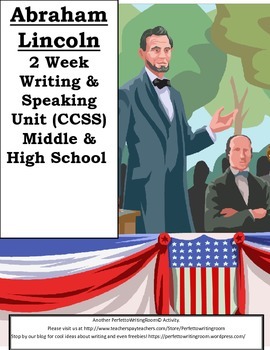
How about Debate, Argument, History and Quotations of Abraham Lincoln in your English Class?
                         Writing Across the Curriculum with Abe !!

ABRAHAM LINCOLN- 2-week Writing & Speaking CCSS Unit. MiddT

What is great about this two-week unit is that it is completely balanced for speaking, listening, and writing. 
There is a journal component, and argument and debate component, a recitation, a major in-class writing activity, as well as small one-day activities that are all based on some of the best of Abraham Lincoln's quotes. 

Of course as you'd come to expect from the best items on TPT, this item comes with a rubric, Common Core standards, directions, and it easy to follow. You can of course make it your own and use what you want or rearrange it. And there is more material than you need. Though there are five journal days, there are ten choices, for example.


This product can be used any time of year but supports social studies teachers and can be used in a cross-disciplinary way. Because of the debate element, many current events can be discussed as well. Consider


Visit PerfettoWritingRoom for TPT TIPS FOR TUES and every FEATURE FRIDAY. We'll keep the Coffee hot and ready for you, and we're always here to talk: TPT; Tips for sellers; great new products; and wonderful sellers like YOU!

Have you not joined TpT? Let me refer you!


TELL US WHAT YOU THINK!!!! ANSWER BELOW! . . .
1. What is a fantastic cross-curricular or cross disciplinary lesson you've done YOURSELF?

2. What is a fantastic idea you wish you'd come up with?


3. Is there any trend in this Writing Across the curriculum, cross-discipline movement YOU WISH they's STOP doing?


We Love hearing from you!

Friday, April 25, 2014

FEATURE FRIDAY - ELA Test Prep, It can be done, and FUN, with Teacher's Craft!


Hi, I'm Gina of PerfettoWritingRoom and welcome to FEATURE FRIDAY! Is is me, or are these Fridays just whizzing by?
    It is test prep time, and since it is still April, poetry is on the menu. Because teachers love poetry, we have this idea that students are going to naturally love it too. But if you add to the mix the nervous energy of test taking and the pull of vacation, you have a volatile and often disappointing recipe that will leave you frustrated.
      I have a few ideas that I have implemented in the classroom that might work well to keep students engaged in poetry and also serve as test prep. Additonally, I INVITE ALL READERS to SUBMIT their IDEAS!    And today I wanted to share with you an idea from my newest friend, Laney Farrugia, known as Teacher's Craft, who has something she implements regularly and finds works wonders for poetry knowledge, appreciation and test prep, too.

If you want to get a cup of coffee, now is the time . . . 
 are ya ready? Good!
Poetry Test Prep - Fun and Easy

I champion creative writing and poetry, and little wonder. Do you have any idea how many skills are transferred over to other areas of thinking and writing - you know, the areas that we consider "important"?

There are many standardized tests for secondary students, to name one might lead you to think that I am only talking about that test, so let's include them all. English language arts includes many skills, and often, the ones tested may include:

Writing
  • Grammar
  • Language usage
  • Word choice
  • Essay construction
  • Sentence mechanics
  • Organization
Critical Reading
  • Vocabulary
  • Main idea
  • Inference
  • Fact vs. Opinion
  • Logic
  • Semantics
This does not include Subject tests. Students benefit from knowing how essays work, how to find meaning and subtext and of course to understand terminology. As April is poetry month, you can make the most of the time when things are in bloom by using poetry's transferable and plastic capabilities. Nearly ALL OF THE SKILLS needed in critical reading can be applied either to essays and large swathes of text, or to more manageable but equally challenging poems. If you organize your year so that you are doing poetry in April your students will thank you. 

1. Let students TEACH EACH OTHER. - We are all about getting the sage off the stage, right?
I love being the sage, don't get me wrong, but once you present the necessary components of a poem, and the terminology that might be asked on a test (some examples might be the parts of a poem, figures of speech, other literary tropes), students can create questions on TASK CARDS and ask them of each other. Students can make educational videos, be the teacher for the day, be in charge of ONE major element you (or they) choose or decide upon, or more. 

2. Play a GAME. Whether you up the stakes with a special privilege to the team winner, give one team bragging rights, or prefer a more community helping vibe, it's your call. It is spring. Can you and your students leave the room? In the game above where students ask questions about a poem, students can actually hide some of the task cards they created, and you can allot points for how fast the other team finds them and then answers them correctly (this ensures the students WANT to find the cards, ha ha). 

3.  Make the students WORK HARD. A poem is a thing that comes to life the more you look at it, read it, ask questions of it, and unravel its layers. And yes, test makers know this too. So everything from meter and rhyme scheme, connotation and denotation, simile and meter, reader response, tone - questions that are analytical to questions about simple vocabulary - it is ALL fair game.  And the more students do this, and the more they take the lead and challenge each other, the better. 

The point is in the end students are BETTER at analyzing poetry and understanding how a poem works and what a poem is. They are more prepared for a test, but even if they are given a short story or essay in the future on a standardized test . . . they will be significantly better prepared to tackle whatever is in front of them. They will be better, more critical thinkers. Poetry has a way of doing this because of its compact nature. It is to an even greater degree than short fiction, very complicated. There is great reward to be had in teaching short fiction and poetry in your classroom, and yes, the skill required in working with poetry transfers to other forms of reading and writing.


Poetry Test Prep with My New Friend


Also known as Laney

You know how I get when I meet other wonderful English teachers. Some of my very best friends are English folks. And there's nothing better than a cup of coffee and a new friend. Laney, who lives in Naples Florida, was an intensive Reading/Language Arts teacher in a Title I school for five years. During that time, Laney was consistently on the Top-10 List of reading teachers in her county. In fact, she actually ranked number one in her third year, which is quite an accomplishment!
        Awards and accolades aside Laney Farrugia told me that "What really made my heart swell as a teacher was hearing students say to me, 'You’re the first teacher who has ever told me I’m smart.' or when former students would tell me that I am the reason that they love to read." 


Like me, Laney Farrugia, aka Teacher's Craft, loves adding items to her store, and she has recently added hard goods like craft items and teacher decor - something I know that she is excited about. What most excited me was how SHE ENGAGES STUDENTS WITH POETRY and INCORPORATES TEST READINESS

Oh, Let's Take a look . . .Poetry Standardized Test Prep


Teacher Craft's (Laney's) Poetry Standardized Test Prep is wonderful for so many reasons. It not only teaches important poetry components, it teaches test components and then allows students to practice in class as if it were a standardized test. It is not unlike walking you through your own Kaplan training program, except you don't have to go to school for it or pay for any training at all. Just use the Power Point along with the students and they will benefit.


This is an essential resource that has been successfully used in the classroom. But let's talk about why. 


1. It is not a quick fix - it is a long product that begins with the basics, walking students through the foundation. Rhythm, speaker, line, stanza, etc.

2. You choose how you want to use it. Do you want to do a few slides a day? Fine. If you want to do even more, well you can do that, just review it beforehand and figure out what your game plan will be. Have students take notes (probably an even better idea). If students know the earlier stuff, then you can enhance it by discussing things you have recently done in your own classroom or use the material as a launching point to discuss them in further detail. If they do NOT know it, then you can just go slower.

3. Parts of a Poem - I like that when you are done using this product students will be familiar with all the basic terminology, as well as the more advanced material. It isn't just for test prep. It is for learning about poetry in general.

4. Review and then the tackling of all the types of questions standardized tests ask about poetry. As a teacher, I love providing my students with keys. I know they have to use their own minds to figure out how those keys fit. I also know they may have to run madly around the castle staring at odd and various locks, always wondering how this or that may fit. But the best tools make it easier for students. THIS makes it methodical and so much easier. Clean and organized and dare I say fun?? More like a grand tour around the castle in a group . . .

5. Practice and Examples for each. Ooh La la. There is nothing better than preparing students for examples of what they might see, so they can recognize what type of question it is, understand what is being asked of them, and better figure out how to answer that question. And all of it is in one resource.

6. It has multiple benefits.  It helps students understand poetry on multiple levels, regardless of testing. While the practice questions help students be prepared for a test as stated above in number 5, the fact remains that students are in fact learning the concepts - this is evident from the beginning, as poetry concepts are introduced and demonstrated and the focus in not merely on how to improve one's score.  Very much a "treasury" resource - one you want to hold on to and use for years to come.


Laney of Teacher's Craft is so happy to be tutoring and staying home for awhile with her son until he is old enough to attend school, and of course making wonderful resources for teachers.
Her fantastic product . . .
Poetry Standardized Test Prep is available
 in her store Teacher's Craft along with so many other resources for teachers. It was a true pleasure having her with us today. 


*If you're looking for the mother of all literary term glossaries, and consider yourself a bit of a wordsmith, pick up the Complete Literary Term Glossary by PerfettoWritingRoom, with nine quizzes and keys, and such fascinating and useful terms that it will be a resource you will come to personally treasure. 

We look forward to seeing you next week for TIPS and FEATURES! We'll keep the coffee hot and ready for you!
Be good, PerfettoWritingRoom

Are you thinking of joining TpT?
Let me refer you.


Sunday, March 2, 2014

The Characterization Master Course is DONE! And, "Name as Characterization" FREEBIE?

And yes, it is now available for purchase at teacherspayteachers.com


     http://www.teacherspayteachers.com/Product/The-Characterization-Master-Course-CCSS-With-Analytical-Essay-Grades-9-12-1140265


    Have you ever felt wrung out? Well, eighty pages later, that's how I feel. I think I MAY take a break for a few days!!


          but before I do, I want to leave you with a fun, easy to do and gosh, do I DARE do it again. . . FREE item for you that is inside my "Characterization Master Course."  It's fair to say it would be better if you could "grab it" as you go on other sites. Believe me I'm working on it! And if anyone has any ideas??? You are welcome to contact me at ThePerfettoWritingRoom@yahoo.com


This is my business email. You tell me how to post Freebies, and I'll start doing it! In the meantime, you can look below, or wait until it is posted on the store. I'll let you know when it's up for grabs.


The Sweet Spot in Names and Characterization


In the meantime. . . I was thinking about the agony and ecstasy of names, product marketing, and its relationship to characterization. Sadly, naming your character "Slim" because he's skinny is usually as unhelpful as calling him Dave.
    The key in my opinion is to do as Emily Dickinson suggestion. Tell the truth but tell it slant. Instead of naming someone ironically or literally. . .

Chose words that inspire the imagination but, as Dickinson suggested, are indeed slant.

     In the carefully organized "Characterization Master Course," every detail is considered, the methods or ways in which to indirectly characterize, for example. One of the lesser explored methods is through the naming of characters.
      I once wen tot a doctor named - don't we WISH we could make this - Dr. Lambert Woolley. I was not actually working on a character for a story, nor even working on a name worksheet at the time. And drats for that. But how rich, how silly, or fun, or interesting, to the extent that it gives the finder of such a name (in particular me) IDEAS for character!!! Now THAT's a great a day at the doctor's office.
      A FREE suggestion is complimentary for my readers. Please no reselling or sharing. This is for you along as a writer, or as a teacher for use in your classroom only! Very soon, I will figure out how to attach (Does blogger have this ability?) If any reader knows, let me know. Otherwise I'll come back and give you all the address for the free download!


Slide81


Monday, February 24, 2014

Using fiction writing as a springboard into analysis -


sale-web-banner-300x250
http://www.teacherspayteachers.com/Store/PerfettoWritingRoom


Please visit for free items and reasonably priced items that make your life easier.


And now. . .


My characterization master unit will be launched in several days. So it a perfect day to broach a heavy subject. Is creative writing, writing prompts, all of these fiction writing classes or courses just a bunch of useless fun, or do they serve a purpose? I avow that fiction writing in many aspects MORE difficult than most of the essays set in our school systems, for one simple reason: a scene or story is often an unchartered territory with guideposts but no formula or template. Write in and remind me who said this, or something like this:  "the question is never 'how do I write a story?' but, 'how do write this story?'"


Championing Fiction Writing in Order to Underscore its Relevance in the Classroom
Every time a person approaches fiction, the degree of critical and analytical thinking necessary to "successfully complete" is staggering. In fact, many people do NOT "successfully complete." The writings are attempts. They are worked on, occasionally at length, and eventually abandoned. I have had the honor of studying under a Pulitzer-prize winner author who regaled us with a story of his many failed short stories, and even novels. Please believe me, the difficulty level, and therefore the degree to which writing "story" challenges a writer, is beyond that of a typical compare contrast. IF THIS IS THE CASE, what skills are they learning in fiction writing and how can students use these skills when going back to the essay form.


1. Elements a writer must contend with - (setting mood, character, plot, point of view, where to begin and end, diction, plus order, grammar, mechanics, style, support of ideas); Some are the same. During this time, students are mastering the same key skills they need to master in traditional essay writing. Even supporting ideas; while nonfiction writing may need the use of quotes, both fiction and nonfiction will need details in order make the reader believe what the writer, or in the case of fiction writing, narrator, is saying.


2. Critical Thinking - Often times, students of fiction need to think ahead in time to figure out a viable path for an interaction between two characters. Writers need to use logic either to explain how a scenario unfolded or to arrange scenes, demonstrate causality through their writing, develop arguments as seen in dialogue between characters, supply pertinent details in order to portray characters believably.


3. When Paired with the Appropriate Nonfiction Essay. . . MAGIC HAPPENS. I am not quite finished with my Master Characterization Unit. However, I think what is very important, whether people buy it, or whether folks just take away the IDEA of it, is that teaching the exhaustive ins and outs of characterization makes it INFINITELY easier for students to then write an analytical essay about the characterization in a fiction story. It is rather simple to choose three to five examples, allocate one paragraph to each example, stating whether each example is direct or indirect, and then analyzing whether the example was successful and why. Students by now are very familiar with making paragraphs. They usually struggle, even in high school and in grade 13 (yes, that's college) with analysis and making sound arguments. If you have spent good time writing and studying characterization, writing a nonfiction essay on a public domain short story and analyzing the effectiveness of its characterization is a fantastic culmination.


4. To close Point #3 after writing your own scene and studying characterization, a student is uniquely suited to then writing an essay about the topic. In short, fiction and nonfiction are two peas in a pod, sorry for the cliché.
Please know that I will be done soon. But feel free to stop by my store anytime. I have freebies and reasonably priced goods. All you have to do is write, or teach! and in a few days we are having a sale!!http://www.teacherspayteachers.com/Store/Perfettowritingroom

Friday, February 21, 2014

Why the "Show Don't Tell" Mantra WORKS for Nonfiction and Essay Writing Too!


Ok, maybe I'm getting a little crazy with giving away all my good ideas. But karma is a great thing. In the spirit of forwarding creative writing, I've got something to say about "Show don't Tell." Many of these ideas are available in my upcoming product on teachers pay teachers, "Characterization Master Course: Fiction and Nonfiction Writing and Analysis with CCSS"


In this upcoming super master course, I separate Direct and Indirect Characterization from the "Show don't Tell" rule. They are different, in that the latter is really a guideline that teachers offer up as a reminder, or, that often attempts to describe the difference between indirect and direct characterization.


The fact is....and here is where you might want to take some notes, folks...


Show don't tell at its worst can be damaging to students who then go on to over explain and guild every sentence with one hundred adjectives, embracing the spirit though missing the goal entirely of what this guideline implies. At its best, "Show don't tell" ALSO offers up simple rules that CAN when used PROPERLY - this being the key word - help fiction writers and NONFICTION writers be stronger, more engaging writers.


Some General Rules People Attribute to "Show, Don't Tell"
One of the guidelines writers have offered up regarding "Show don't Tell" have to do with the use of verbs and adverbs. Many of the rules are tailored for fiction writing. The takeaway is that some of the rules in practice are useful in essay writing. For example:
    - active over passive
    - avoid "to be" verbs
    - use adverbs when necessary, otherwise, again, use a stronger verb
    - It is better to write in simple tenses (present or past) rather than the progressives (ing),
      or with the "As" construction ("As I knocked on the door, I readied my suitcase and calling
      card.")


There are more. The crux is the by applying these rules to writing, whether it be a story or an essay will yield a stronger product, and by doing this repeatedly over time will result in a stronger writer. As you se below, this is an example of the standard "overwriting" students do in an attempt to be scholarly. The first example is too long and uses unnecessary phrases. The second uses strong verbs.


Nonfiction essay writing example:
analysis of Mary Shelley's Frankenstein


First Attempt: In the novel, as Dr. Frankenstein views the creature for the first time, he's horrified
             by the monster he had created.
After: Victor refused the monster he had toiled to create.


Next time... more discussions and freebie ideas leading up to the major launch.


All the best, and until then,
Happy writing, reading and teaching,
Gina
PerfettoWritingRoom


Thursday, February 20, 2014

The Characterization Master Class & Nonfiction Writing With Freebie Ideas


Now that I am working, day and night on A Characterization Master Unit – It occurs to me that a lot of . . .

FREE information can be passed along to readers, writers, and teachers. Of course there have been some puzzles along the way too.

Is there a difference between Showing vs. Telling, and Indirect vs. Direct Characterization?

It has occurred to me that there aren’t many definitions out there for showing versus telling, or for that matter, direct versus indirect characterization, only a lot of explanation and writing, with many examples that take up PAGES. In fact, the more I thought about it, the more I realized these three truths:

1. Showing versus Telling is a “golden rule” that describes the difference between indirect and direct characterization. However, in some respects, it goes beyond the realm of character because showing involves setting as well.

2. As a result, direct and indirect characterization aren’t exactly the same as the “Showing vs. Telling” mantra. There is some overlap however. Direct and Indirect characterization, which I will speak about a little later, each have guidelines, and yes, a definition. “Showing vs. Telling” oddly enough, over time has turned into a broader definition for STRONGER more visual writing which serves in fiction writing as well as nonfiction and essay writing.

3. Contrary to even the idea of “Show don’t Tell,” direct characterization (or telling) is often needed and can be indispensable to writing fiction. Simply put, you can’t write a novel of 400 pages with pure indirect characterization. Sometimes, you must directly state. The art comes with knowing when to show, and when to tell.

Today’s Discussion – So What is Direct Characterization and Indirect Characterization? Clarified!

Direct- When the writer states or reports information about the characters to the reader, resulting in distance between the reader and the characters. The reader feels this way because the strongest voice is that of the writer/narrator who is delivering information directly and who in a sense stands between the reader and the character. The information may be the same as that given in indirect characterization (appearance, physical description, mood, even speech) but it is reported by the narrator,  and not shown visually. As a result, it is told a lot quicker. It's benefits are that it can pick up the pace of a slow story, can advance the story and help readers read past the less important characters and differentiate major from minor players.

Indirect Characterization – unlike direct characterization where the writer or narrator directly provides information to the reader about a character, in indirect characterization, the writer “tricks” the reader into feeling that the information is coming from the character, which results in a deep connection with the character.

This includes dialogue in which the reader can pick up accent, opinion, and attitude; movement, including physical ailment or energy; responses, actions or reactions to a major event a discussion or comment, whether it be a large body movement or even a small facial expression; physical description, which may indicate something interesting, ordinary or ominous; Thoughts, feelings, dreams or even daydreams, which provide a close intimacy with the character that people do not have with others in real life; name, an optional indirect characterization move that offers information about a character; responses of other characters, through their dialogue or body language; character choices; and friendships.

I hope that helps….

More tomorrow, and always feel free to pop into my store for reasonably priced writing goods as well as free stuff.
http://www.teacherspayteachers.com/Store/Perfettowritingroom

Wednesday, January 15, 2014

A love letter to creativity in general and creative writing too

I have often lamented the loss of art, music, creative writing and other creative arts in the school system. I also tire of the never-ending struggle to keep these classes, the anxiety about funding cuts, or the feeling teachers have that they need to "justify themselves" when they add creative elements that may "detract" from other lessons deemed more essential.

I am astounded that some people still think creativity = easy and bad. Is learning a musical instrument and musical notation easy? Is writing a short story easy? I can attest, as can many of my students (and I'm sure you can as well) that creative tasks require more of your faculties and brain power, a wider array of skill sets, and both sides of your brain than many other tasks do.

I was once accused of not teaching properly, or sufficiently, when I introduced my high school students to children's books. It was a fiction class. The goal of this particular activity was to have the students analyze a number of children's books and picture books and come to series of conclusions about the way these books are written, their font size and placement, etc. in order to learn and then create their own complete creations. The department head only thought I was making a "dumbed down" and "inappropriate" lesson. She thought I was asking them to "write at a kindergarten level" - after all the parents expected a lot more than "Dick and Jane are friends" for sentence structure! She really missed the entire point: creativity, critical thinking, owning the entire process. Clearly I am glad to not be there anymore.

If she misunderstood me, and this was an activity in a sanctioned fiction writing course, I can't even imagine the degree to which other teachers are being maligned for attempting to encourage students to be creative and write stories in regular classrooms.

Turn that Negative into a Positive. . .

Creativity is the most important tool we have in our arsenal against indifference.

Whether we teach math, geography, science, history, art, or physical education and health, we can be creative and fun ourselves, which is how we bring wonder and excitement into the classroom.

What about Creative Writing? Isn't it Just a Waste of Time?
I think this has me a little angry.
I can't tell you how difficult it is to write stories and poems, and to write them well.  True poetry writing and fiction writing aspires, has goals, is work shopped, is graded. While it can be exhilarating, exciting, and great fun, it is challenging and can be frustrating as well. And at times, it is just plain difficult. There are rewrites. The students get stumped and feel challenged.

Story writing is even MORE complicated than the very best of essays and papers. Stories are dynamic and there is no such thing as "how to write a story." No, no formula, despite that drawing of a nifty little "arc" in those fiction writing books. Every single story is unique and varied and is organically derived from the student. There are threads, through lines, dialogue, one character or many, various settings that might or might not occasionally forward the plot, and an arc of some type. One must think of foreshadowing, mood, and must describe clearly. 

Sometimes, students will even do research in order to know more about the topic they are writing about. In fact, the research is not a big deal in the way the "research paper" is; writing a good story is so involved that doing research is usually just background to the story they are telling. Research is simply a part of the job!

So I ask you. REALLY? Fun but a little too easy? A waste of time?

A Comment on the Essay

So writing stories is easy and a waste of time (I haven't even told you how hard it is to write a poem. Maybe another day). Essays and research do not hold high court in the world of words and meaning. In fact, the more capable students are in a multiple of forms, the better. What is difficult about research is thinking critically, making original points out of the points out there, and less so, notating. All of this should be done often and regularly. And, so should many other forms of writing, including poetry, argument, story writing, and OTHER forms. Hey, how about REAL letter writing? Remember that? Now that's something we should all blog about! How's that for a lost art form?

Creative Writing - Of Immense Value - NINE SKILLS (and maybe more)
Of course there will be a transfer of skills. This is not the difference between skiing and learning French.
  1.  Learning to organize thoughts,
  2. create full sentences, paragraphs, and to a certain extent,
  3. argue,
  4. look up background information that will be used in the work,
  5. use logical order and
  6. explain things in a clear way, 
  7. practice economy, and
  8. obey spelling and
  9. grammar rules
are just a few of the transferable skills students will learn through storytelling that will prove a boon when it comes time to writing a paper. In fact, students may even be more motivated to improve if they are working on stories.


I Leave You With This


Is THIS Why Folks Say It's a Waste?
Don't Judge a Book by it's Paper Bag Cover?
If you look above, I guess if you saw me bring these things into class, and you weren't very open minded, you'd think I was playing games and not challenging my students. You'd think I was going to read a newspaper or something while they fiddled around and then got bored. You would certainly not think I would be engaged the entire class, and that the students would be engaged. You'd never believe this was serious "life or death stuff," ending in a workshop dealing with full length stories about super spies, wars, and other heavy stuff. But you'd be wrong!

 I've mentioned this activity before - It is the SUPER SECRET - 4-SENSES Writing Activity. Take all of your little treasures and garage sale finds, and put them in brown paper lunch bags.

Step one. Students choose only by feeling. Write a description using only touch.

Step two. Take it out and LOOK! Now you can write about what it is and describe it.

Step three. Now only use metaphors and similes.

Step four. Your object isn't what you think. It is a weapon, a spy device, a portal to another dimension, of incalculable worth, has a long story of excitement and adventure, has a spell on it and a story only YOU know, has the ability to heal two warring peoples (offer other suggestions). TELL the full and complete story of this object the day you main character finds it or gives it away.

PS. This is a paid-for product on TPT, (there is extra of course in that one)...but I'm illustrating a point.  The students are pushing to use figurative language, they are using outside of the box thinking, (other senses in order to write, such as feel, and in the paid for version, they are instructed to use sound, etc.),  and they are surprised and told to switch gears. They feel internally motivated to write because they have a lot of options to choose from and it feels very immediate and very cool to them that what they are being presented with is something different. They "play along" - I've even done this in colleges, and they do it willingly. It somehow opens something up in them, and all of the NINE SKILLS are still being used, ready to transfer when you want them to write that argument essay.

God Bless, and happy teaching.

Gina

Wednesday, October 30, 2013

Poetry UNITS, And the Value of talking to other Teachers. . .

Today I was on LinkedIn.

I had the good fortune of falling into a group - teachers anonymous of something silly like that. One of the benefits of helping other people is that it really benefits you MORE, almost all of the time. You feel good about yourself, you feel inspired. It feels good to do good. And then there's the fact that you read about all these other fascinating ideas teachers have for poetry units.

The found poem is always fun. The acrostic? - why not... One professor suggested giving each student half a line, and having that student meet up with his or her "other half" in order to discern the line's meaning. Still another teacher suggested drawing the impression or meaning the poem has for them. A final one I read thought a variation on the "cut up" poem would be fun. Instead of cutting up the entire poem, just cut out certain phrases. Students can fill in what they believe would work provided they can justify it.

I've always thought the Exquisite Corpse works well, whether you are doing it for the short story or for the poem. Most people don't call it the "Exquisite Corpse" because it sounds eerie and odd, but most of us have done it before. If you use rows, and have five students in each row, each has a sheet of paper. The entire class begins their versions of a story, OR a POEM.
      When they have gotten a stanza or a few good lines down, each person passes it back (well, except for the poor people in the back who must run very fast up to the front. Now, everyone quickly reads the first stanza, and continue the poem, until it is time to pass back again. When each person has the honor of getting back his or her paper, let everyone read, and then finish their own poem. This round will take the longest.  Everyone may share out loud afterwards.

If you want a longer more far-reaching and skills-based poetry unit....

An idea I have had much success with is using the Romantic Poets. This is nothing I am currently working on for the PerfettoWritingRoom. If and when I do, it will be a full unit. Whether you do one poem from each: Shelley, Wordsworth, Blake, Coleridge, Byron, Shelley, and Keats, use the poems of the Romantic poets that are available in your text, choose your favorite or have the students choose their own, it can be very successful, and will have a different slant.

Once the poems are chosen, create a prompt for each poem. Assignments can vary and can be: personal reflection, close reading, summarizing the poem but moving on to a related writing topic, or a targeted writing activity geared towards studying the poems' literary devices, structure, pacing, symbolism, tropes, or other goal you may have. Ideally, you may want to do a variety of each of these, not just summaries, or reflections, etc. I always got permission to take the student out of school for one or two periods, to sit outside and read poetry as the Romantics would have done. This was Grade 11, and they appreciated it and as a result were reasonably well behaved!

The Unit grade is based on a major test that includes all of the poetry and information covered, all of the writings done in the "Poetry-prompt journal," as well as one-two poems they must write that use the style and the subject matter of the Romantic poets. Lastly, there is a small art component: some students take pictures of nature, other draw, sculpt, do computer renderings or animation. For those who "swear" they are completely dull at art, an extra poem or two may be submitted.

Outside of the unit itself, there is a major poetry analysis paper in the works; this is not included in the unit grade, but shows that the students have a very well-rounded activity and lesson load during the spring. I feel it is very holistic, or "whole-istic."

I hope you think this is a useful approach to teaching, not just "a few poems" but the style and structure of poetry, and background of the poets, all the while giving the students some time to slow down and soak up some sun, time to reflect and write as the Romantics themselves would, before quizzing, testing, and writing an analytical paper and some poems of their own. Who knew you could be so industrious in March?

I hope you enjoyed my idea for the Romantics teaching unit. So in the spirit of talking to our teachers and yes, our writers too, any other ideas for great poetry units? I'm all ears. Stop by and drop me a line, or visit my store, posted on the side bar of my main page.
Best,
Gina
PerfettoWritingRoom