Showing posts with label Feature Friday. Show all posts

Friday, May 16, 2014

Feature Friday - Across the Curriculum with Colleen Bergin


I am Gina of the PerfettoWritingRoom, One Word, One Store, Welcome to another edition of Feature Fridays, with your host Gina, @ PerfettoWritingRoom, One Word, One Store, One Blog, and ALL things writing!!
     TODAY, we're talking that catchiest of catch phrases - writing across the curriculum, or cross disciplinary writing.
     Just as math, social studies, science, (etc.) teachers are being encouraged to incorporate writing in their curricula, so too should English teachers be spreading our student's wings and asking them to write about topics OTHER than Jane Eyre, Shakespeare, or whatever poet or author we are working on. I know, perish the thought. 

Once students are out of school they will continue to use social media and research, but will grow in other areas, including proposals and other types of business writing. 
      They will be expected to have knowledge of the world outside the strictures of the English classroom and so any way we can reinforce other disciplines through writing will better prepare students for their future lives. I was half-joking when I said it was a catch-phrase. 

Writing across the curriculum was a movement started in universities to stave off the "massacre" of time loss that was happening when students came in as freshmen and sadly didn't know how to properly write at the college level. The fact that writing is now strongly encouraged in as many courses as possible at the lower levels is absolutely essential. Written expression is essential. I don't think I need to go on about this. 

OH MY GOSH! I ALMOST BURNED THE COFFEE AND COLLEEN IS ON HER WAY!!


Get yourself a cup. Relax. What is wrong with me today? And let's introduce the intelligent, thoughtful Colleen Bergin. Our guest for today!


Visit Colleen Bergin's Store - Now, her new logo! 
Click on EITHER! 


LIKE ME, Colleen Bergin also is a strong proponent of  writing across the curriculum. I asked her about it and she said:

"I am a strong advocate of Writing Across Curriculum.  Students need to write whenever they can and learn Academic English.  Restricting writing to only one course does not help as writing is a huge aspect of life whether students realize it or not."

Colleen, or Ms. Bergin,  always brings world events to forefront in English class. She adds that "It's current and interesting for students as they can learn about it in real-time. Students prefer to do informational texts on current events rather than something that happened 50 years ago.  If it's anything to do with anywhere in the world, I find students like to learn about the culture and compare to the culture here in the USA. It's a great way for students to see that world events can fit in anywhere, not just history class."


YOU CAN'T KEEP THIS TRAVELER DOWN!  BIO TIME!!
It's little wonder Colleen loves current events as she's a little bit of a traveler and lover of adventure and travel herself. Colleen Bergin Attended Title I school in Connecticut through high school and is the only deaf child of six siblings. She uses hearing aids and lip reading over sign language though she is fluent in ASL. 
     Ms. Bergin graduated Roger Williams University in Rhode Island in 2010 with a BA in English and Education and rather than letting any dust collect, moved to North Carolina six months later with nary a job or apartment lined up! 
    She worked hard in an ELA all boys 7th grade class for one year before moving on to where she teaches NOW. . . High School English baby, because it's the BOSS APPLESAUCE!

Like ME Colleen  loves traveling - unlike me, she is actually getting to do a backpack-through-Europe trip this summer! (ugh am I jealous, but I am also 40, 41 come June 29 and frankly in no shape for camping or "hostel hopping" anymore, but still, very great for Colleen! Sad for me.). She loves the Outer Banks, the beaches of Rhode Island, spending time with family and friends, READING (can I get an amen on reading and family please?), and you can find her playing tennis in the park. You can find me trimming the hedges in the back yard. I'm chubby. It is process. . . 

And Ms. Bergin likes Grey's Anatomy, Once Upon a Time, Bones....
Me? Grimm, Cosmos, and shows they will be cancelling like Believe, Almost Human, Resurrection. The horror.


 HOW CAN WE IMPLEMENT WAC???
Writing across the Curriculum is connected to READING. Don't let anyone tell you different. here's a great, sad, fantastic, awesome Facebook picture I saw yesterday. 


THIS IS relevant to Writing Across the curriculum. How is reading NOT related to writing?
Those who regularly read are better able to organically write and write properly, without exhaustive instruction, and they usually require less intensive editing, simply because they internalize structure, vocabulary, organization and more as they read.  This is not unlike how how infants pick up new words from listening. Reading much will silently TEACH you to be a better writer. (Sadly, if you read too much Truman Capote you may write JUST like him, but that is a different argument for a different day). 

EASY TIPS
1. Read in class
2. Create incentives for reading at home
3. Read literary but also popular and current literary books that students enjoy.
4. Assign nonfiction reading that is connected to lessons they will be required to participate in the next day or day after.
5. Students read in order to teach others.


The SAME RULES APPLY for WRITING
1. Write in Class
2. Make incentives for writing in the home
3. Make writing connected to literary works, and to current literary works that are popular to increase 
the desire and willingness to write
4. Make writing of the nonfiction variety, and also applicable to lessons they will be learning tomorrow (and the next day...) so it is necessary for them to write and be prepared for class.
5. Have students write that specifically have to job with JOB SKILLS, science, Math, teaching others, as well as the forms we are already doing (how to, narrative, argument), but expand current events to include other disciplines. 

WHAT DOES COLLEEN BERGIN HAVE UP HER SLEEVE??? SOMETHING COOL!!

                 Colleen Bergin's Best Seller


It's never a good idea to give away too many of your great ideas.
Colleen Bergin's "What's Going on in the World Today" is just fantastic. 

-It encourages students to delve into the real world, 
-write in a way that develops critical thinking (for themselves and 
   those who read or listen)
-think outside the classroom to issues and events that matter
- Use writing as a tool to express what is going outside this 
   classroom.  
- Rigorous in challenging students to use proper sources.


So What Does it Include?
  • With a POWER POINT
  • Helpful links for research into different countries
  • Directions
  • Rubric
  • Annotation Guide
  • Research Guidelines


In short it's nothing short of an INTERNATIONAL current event Presentation Project that challenges students but makes the set up a whole lot easier for teachers. I also like that it is an ongoing project!

Do you have ANY OTHER IDEAS?? 
WELL SURE!!
Don't get me started on how important creative writing is to critical thinking skills. But that is not quite writing across the curriculum, is it?

How about Debate, Argument, History and Quotations of Abraham Lincoln in your English Class?
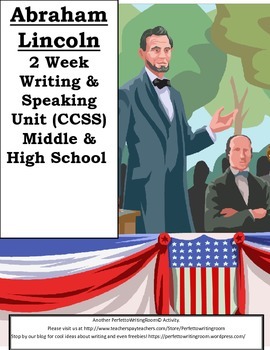
                         Writing Across the Curriculum with Abe !!

ABRAHAM LINCOLN- 2-week Writing & Speaking CCSS Unit. MiddT

What is great about this two-week unit is that it is completely balanced for speaking, listening, and writing. 
There is a journal component, and argument and debate component, a recitation, a major in-class writing activity, as well as small one-day activities that are all based on some of the best of Abraham Lincoln's quotes. 

Of course as you'd come to expect from the best items on TPT, this item comes with a rubric, Common Core standards, directions, and it easy to follow. You can of course make it your own and use what you want or rearrange it. And there is more material than you need. Though there are five journal days, there are ten choices, for example.


This product can be used any time of year but supports social studies teachers and can be used in a cross-disciplinary way. Because of the debate element, many current events can be discussed as well. Consider


Visit PerfettoWritingRoom for TPT TIPS FOR TUES and every FEATURE FRIDAY. We'll keep the Coffee hot and ready for you, and we're always here to talk: TPT; Tips for sellers; great new products; and wonderful sellers like YOU!

Have you not joined TpT? Let me refer you!


TELL US WHAT YOU THINK!!!! ANSWER BELOW! . . .
1. What is a fantastic cross-curricular or cross disciplinary lesson you've done YOURSELF?

2. What is a fantastic idea you wish you'd come up with?


3. Is there any trend in this Writing Across the curriculum, cross-discipline movement YOU WISH they's STOP doing?


We Love hearing from you!

Friday, May 2, 2014

FEATURE FRIDAY 5/2 - Crushing Customary Common Core with Julie Conlon


Gina, Your Host of PerfettoWritingRoom,
RIGHT, my new friend Julie Conlon and
beautiful daughter Rory!

Has May actually come again? Here at the PerfettoWritingRoom, it's Friday once again. The time when we get to do some of our favorite things: talk secondary English, classroom joys and challenges, make new friends and discuss great ways to improve our classrooms. 

Before we do much of anything get your morning cup of coffee ready. I just made some banana bread with raisins because my husband hates nuts (so why'd he marry me? Am I right?) Should I give ya a minute? Let's get this place percolating!


1. Odd and Brilliant Ways to Use the Common Core in May, when, you know what? The student just aren't having it . . .!
                              visit my store    

 I LOVE nothing more than a great writing prompt that PROVES the inestimable value of poetry or fiction writing. I also love nothing more than proving all those nosy parkers, extra chefs in the kitchen, or spoon stirrers who want to say that such writing is fun, "has its place," but otherwise is useless and is without rigor, or that say there aren't many common core applications.

I know for a fact that after disciplined and targeted poetry and short fiction writing, students often feel an ease in the essay format, as if there is somehow "more room" for them to write, and it is suddenly a simpler format than they remember. This is true across the curriculum, whether students write in history class or art class or in biology.
      I put out a product called "Story Starter Prompts with Research and Argument Tie- Ins" - I love this product because it proves that while going through a fiction writing activity, you can use and have students gain mastery in common core standards usually reserved for essay writing. Let's be honest - a type of writing they just don't want to do in March, April, May, and June.
Please look at it here.


I'll do ya one better, and argue that rigorous poetry and short fiction writing can actually be more difficult than some types of essay writing. I'll accept the hate mail, but in the meantime, consider the difficulty involved in organizing a story that FAR from being a formulaic "list your three points and your three reasons with a graphic organizer" (I know that I am simplifying, so forgive me) must consider spelling and grammar just as they would in any other writing assignment, plus organization, back story, realism or purposeful lack of realism, possibly research, logic, cause and effect, explanation and argument all in one story depending on the needs of the particular elements within. Let us not even begin to talk about symbolism, or characters, pacing, believable dialogue. . .should I go on? Is this NOT critical thinking? Are there not applicable common core standards?

ANY poetry of writing prompt you do can have caveats in them. These caveats can be guidelines. And yes these caveats can be aligned with the common core, but I guarantee you that the students will be motivated.


Fickle, Fickle May - And Wonderful New Friend and Lifesaver Julie Conlon
2. How Does Julie Conlon Use Common Core?
When Julie isn't at Disney World or at dance class with her daughter Rory, AND, when she isn't working very hard on Pinterest, she is cooking up really unbelievable lifesaving literacy assessment items like this one. Have you never been to her store? Here's what it looks like and I do ask you, please go for a little visit. Click, Like, download a freebie, say hi. Be neighborly!

                                   Pop in and say "Hi!" or follow


The more I write these articles, the HAPPIER I am to do them. I so deeply enjoy having the opportunity to learn and grow as a result of meeting new secondary English teachers.

The Common Core - a Metaphor!
The common core is a BEAR. A lumbering, clawed, not very sophisticated beast.  To work around the bear you don't have many options. You can run, play dead, but only the truly great come up with something original. The great Bill Cosby joked about killing one with a loose leaf notebook. But then I met the great Julie Conlon who killed it with ingenuity and a great resource


 Much like my Story Starter Prompts that use the Common Core Standards through an unexpected creative writing activity,

Julie Conlon's Formative Assessment Exit Slips are so much more than what you think they are. In terms of making a FUN, usable and flexible Common Core Product, these exit slips hit the mark. They bring down that bear right in the belly (with honey everybody - I love animals!).

What they are not: 
- One dimensional or one-note (write what you don't understand)
- Obligatory (As you walk out, hand these over!)
- Rigid (Here is how they must be used)
*There's nothing wrong with any of those above, but take a peek at the review below.


Let's look at little at this tamed animal. 

See me in Julie's Store so you can look at a preview.


What This Product IS: 
- Based on literacy strategies (Julie was a literacy coach)
- for middle or high school, in any subject where you want to assess
   for understanding and nuances in understanding and critical 
   thinking
- Created and intended as exit slips with unbelievably simple print
  and go forms for you to fold and make into your own little "brain 
  station" anywhere in your classroom and students.
- BUT, respectfully, in my opinion, can be used AS YOU see fit, as
   part of a lesson, or as the lesson (it really is that rich with ideas). 
- Ideal this time of year, but absolutely can be used all year long.
- All common-core aligned reading assessments, with a handy 
   reference guide for the teacher. You know what standard each 
   slip will address. How genius is that. How much less work for 
   you?

Chatting with Julie after I had actually reviewed this resource, what most struck me was the thought, care, and love that went into the product. The multitude of students' learning needs, thinking strategies, and forms of expression seemed to all be accounted for on these slips. It seemed to address all the different learning styles, while helping students show what they know and explain where they got confused. Of course there is more, all the subtle nuances: predicting, pro and con, summarizing, making inferences, and so much more. 
     The more I looked the more impressed I was. I saw how indispensable this would be in any classroom where reading took place (is there a classroom where reading doesn't take place?).  Instead of each week laboriously tackling a new Common Core standard, it was all there on little slips.

Question: How did you do it? 
Answer: The "first draft" of the product (also still available in my store) was my reading strategy exit slips.  I used these to monitor my students' independent reading progress--they were all reading different books, so I needed a way to evaluate their progress that would work for any text.  I based them off of the reading strategies in Strategies That Work by Stephanie Harvey and Anne Goudvis (making connections, questioning, predicting, making inferences, etc.). 


Question: When did you first come up with the idea for a resource that would cover so many literacy assessment needs?
Answer: This set was created when I found myself in my new role as a literacy coach.  Teachers of all subjects were asking for ways to monitor their students' reading comprehension.  I adapted my "fiction-based" exit slips and added more general strategies to create this product.  In the product, you'll see that I give suggestions for using each of the 20 different slips--most instructions include ways to use it with reading or with general classroom lessons.  I even use them in professional development workshops to gauge participants' understanding!   


Question: I hope we have regular workaday teachers and some TPT teacher-sellers reading today, too. Do you have any advice for making products?

Answer: Thanks, Gina. One thing I realized by exploring other stores is that everything is an option. I forget sometimes that ideas/products that are just part of my everyday routine as a veteran teacher could be very useful to a new teacher. I'm trying to look at my files from the perspective of someone new to the profession--what can I share that will make their lives easier than mine was in those first few years?

So whether you are a NEW TEACHER, a BUSY one, or even a TPT seller yourself, pop in to Julie Conlon's store. See her best-selling product. Just click on the live link above. JULIE will be having a SALE. There is no better time than to give your students the gift of learning!


Click the Bloglovin' Button and ....
JOIN US! Come back Tuesday for TPT Tips for Tuesday, where you can learn tips from the $1000 dollar club. Learn how to own your own success and do better.

JOIN US! Come back every Friday for Feature Friday where wonderful Secondary Sellers unite and talk shop! The coffee's always hot and ready for you! (tea optional!).

Visit Me! See my Common Core Story Starters!
Do you want to become a seller? Oh come on, let me refer you!


BEFORE WE GO. . .
QUESTION FOR ALL YOU READERS - 
WHAT IS THE BEST, most intriguing and fun or unexpected way to use the Common Core Standards in your secondary (or Middle School) classroom? How do YOU kill that bear??  

Friday, April 25, 2014

FEATURE FRIDAY - ELA Test Prep, It can be done, and FUN, with Teacher's Craft!


Hi, I'm Gina of PerfettoWritingRoom and welcome to FEATURE FRIDAY! Is is me, or are these Fridays just whizzing by?
    It is test prep time, and since it is still April, poetry is on the menu. Because teachers love poetry, we have this idea that students are going to naturally love it too. But if you add to the mix the nervous energy of test taking and the pull of vacation, you have a volatile and often disappointing recipe that will leave you frustrated.
      I have a few ideas that I have implemented in the classroom that might work well to keep students engaged in poetry and also serve as test prep. Additonally, I INVITE ALL READERS to SUBMIT their IDEAS!    And today I wanted to share with you an idea from my newest friend, Laney Farrugia, known as Teacher's Craft, who has something she implements regularly and finds works wonders for poetry knowledge, appreciation and test prep, too.

If you want to get a cup of coffee, now is the time . . . 
 are ya ready? Good!
Poetry Test Prep - Fun and Easy

I champion creative writing and poetry, and little wonder. Do you have any idea how many skills are transferred over to other areas of thinking and writing - you know, the areas that we consider "important"?

There are many standardized tests for secondary students, to name one might lead you to think that I am only talking about that test, so let's include them all. English language arts includes many skills, and often, the ones tested may include:

Writing
  • Grammar
  • Language usage
  • Word choice
  • Essay construction
  • Sentence mechanics
  • Organization
Critical Reading
  • Vocabulary
  • Main idea
  • Inference
  • Fact vs. Opinion
  • Logic
  • Semantics
This does not include Subject tests. Students benefit from knowing how essays work, how to find meaning and subtext and of course to understand terminology. As April is poetry month, you can make the most of the time when things are in bloom by using poetry's transferable and plastic capabilities. Nearly ALL OF THE SKILLS needed in critical reading can be applied either to essays and large swathes of text, or to more manageable but equally challenging poems. If you organize your year so that you are doing poetry in April your students will thank you. 

1. Let students TEACH EACH OTHER. - We are all about getting the sage off the stage, right?
I love being the sage, don't get me wrong, but once you present the necessary components of a poem, and the terminology that might be asked on a test (some examples might be the parts of a poem, figures of speech, other literary tropes), students can create questions on TASK CARDS and ask them of each other. Students can make educational videos, be the teacher for the day, be in charge of ONE major element you (or they) choose or decide upon, or more. 

2. Play a GAME. Whether you up the stakes with a special privilege to the team winner, give one team bragging rights, or prefer a more community helping vibe, it's your call. It is spring. Can you and your students leave the room? In the game above where students ask questions about a poem, students can actually hide some of the task cards they created, and you can allot points for how fast the other team finds them and then answers them correctly (this ensures the students WANT to find the cards, ha ha). 

3.  Make the students WORK HARD. A poem is a thing that comes to life the more you look at it, read it, ask questions of it, and unravel its layers. And yes, test makers know this too. So everything from meter and rhyme scheme, connotation and denotation, simile and meter, reader response, tone - questions that are analytical to questions about simple vocabulary - it is ALL fair game.  And the more students do this, and the more they take the lead and challenge each other, the better. 

The point is in the end students are BETTER at analyzing poetry and understanding how a poem works and what a poem is. They are more prepared for a test, but even if they are given a short story or essay in the future on a standardized test . . . they will be significantly better prepared to tackle whatever is in front of them. They will be better, more critical thinkers. Poetry has a way of doing this because of its compact nature. It is to an even greater degree than short fiction, very complicated. There is great reward to be had in teaching short fiction and poetry in your classroom, and yes, the skill required in working with poetry transfers to other forms of reading and writing.


Poetry Test Prep with My New Friend


Also known as Laney

You know how I get when I meet other wonderful English teachers. Some of my very best friends are English folks. And there's nothing better than a cup of coffee and a new friend. Laney, who lives in Naples Florida, was an intensive Reading/Language Arts teacher in a Title I school for five years. During that time, Laney was consistently on the Top-10 List of reading teachers in her county. In fact, she actually ranked number one in her third year, which is quite an accomplishment!
        Awards and accolades aside Laney Farrugia told me that "What really made my heart swell as a teacher was hearing students say to me, 'You’re the first teacher who has ever told me I’m smart.' or when former students would tell me that I am the reason that they love to read." 


Like me, Laney Farrugia, aka Teacher's Craft, loves adding items to her store, and she has recently added hard goods like craft items and teacher decor - something I know that she is excited about. What most excited me was how SHE ENGAGES STUDENTS WITH POETRY and INCORPORATES TEST READINESS

Oh, Let's Take a look . . .Poetry Standardized Test Prep


Teacher Craft's (Laney's) Poetry Standardized Test Prep is wonderful for so many reasons. It not only teaches important poetry components, it teaches test components and then allows students to practice in class as if it were a standardized test. It is not unlike walking you through your own Kaplan training program, except you don't have to go to school for it or pay for any training at all. Just use the Power Point along with the students and they will benefit.


This is an essential resource that has been successfully used in the classroom. But let's talk about why. 


1. It is not a quick fix - it is a long product that begins with the basics, walking students through the foundation. Rhythm, speaker, line, stanza, etc.

2. You choose how you want to use it. Do you want to do a few slides a day? Fine. If you want to do even more, well you can do that, just review it beforehand and figure out what your game plan will be. Have students take notes (probably an even better idea). If students know the earlier stuff, then you can enhance it by discussing things you have recently done in your own classroom or use the material as a launching point to discuss them in further detail. If they do NOT know it, then you can just go slower.

3. Parts of a Poem - I like that when you are done using this product students will be familiar with all the basic terminology, as well as the more advanced material. It isn't just for test prep. It is for learning about poetry in general.

4. Review and then the tackling of all the types of questions standardized tests ask about poetry. As a teacher, I love providing my students with keys. I know they have to use their own minds to figure out how those keys fit. I also know they may have to run madly around the castle staring at odd and various locks, always wondering how this or that may fit. But the best tools make it easier for students. THIS makes it methodical and so much easier. Clean and organized and dare I say fun?? More like a grand tour around the castle in a group . . .

5. Practice and Examples for each. Ooh La la. There is nothing better than preparing students for examples of what they might see, so they can recognize what type of question it is, understand what is being asked of them, and better figure out how to answer that question. And all of it is in one resource.

6. It has multiple benefits.  It helps students understand poetry on multiple levels, regardless of testing. While the practice questions help students be prepared for a test as stated above in number 5, the fact remains that students are in fact learning the concepts - this is evident from the beginning, as poetry concepts are introduced and demonstrated and the focus in not merely on how to improve one's score.  Very much a "treasury" resource - one you want to hold on to and use for years to come.


Laney of Teacher's Craft is so happy to be tutoring and staying home for awhile with her son until he is old enough to attend school, and of course making wonderful resources for teachers.
Her fantastic product . . .
Poetry Standardized Test Prep is available
 in her store Teacher's Craft along with so many other resources for teachers. It was a true pleasure having her with us today. 


*If you're looking for the mother of all literary term glossaries, and consider yourself a bit of a wordsmith, pick up the Complete Literary Term Glossary by PerfettoWritingRoom, with nine quizzes and keys, and such fascinating and useful terms that it will be a resource you will come to personally treasure. 

We look forward to seeing you next week for TIPS and FEATURES! We'll keep the coffee hot and ready for you!
Be good, PerfettoWritingRoom

Are you thinking of joining TpT?
Let me refer you.


Friday, April 18, 2014

FEATURE FRIDAY #3: Getting Cozy! The Close Read with Sara Fuller, Gina and Coffee. . .


I'm your host, Gina of the PerfettoWritingRoom(c), store at teacherspayteachers.com and this cozy little blog, where friends meet to talk about TpT and my favorite subjects: English, language and writing.

It's April so let's talk about poetry, and close reading, the coziest of all types of reading.

CLOSE READING - is reading for understanding, though that understanding is one that moves from a simple read-through and "look up the definitions" type of understanding, to a more nuanced approach that is based on LAYERS. There is no strict order in which to follow a close reading process, though the list may look something like this. Keep in mind that EACH article in the list may require you to read again:

  • a simple read through
  • a reading while circling unfamiliar words. These must be looked up and you will read through again, understanding the text as a whole
  • summarizing or rewriting the text in your own words (not required, but this proves your understanding)
  • Noting words that demonstrated sound devices (assonance, consonance, alliteration, etc)
  • Figurative language, metaphor, simile, synecdoche, metonymy, personification, pathetic fallacy, and more)
  • Rhetorical devices 
  • Noting Structure (this includes - meter, rhyme scheme, or stanza, but may also include parallel structure, repetition, internal rhyme, and more) 
  • Tone - in particular the author or speaker's attitude toward the subject or characters being spoken about in the poem
  • Diction (word choice, level, usage).
  • OTHER - this may include historical, cultural, or background information known about the writer, if the piece is known to be semi-autobiographical or not, the period in which it was written or other elements that might enrich the reader's understanding or "reader response" to the poem.
THE Goal of the close read is to have a deeper appreciation and understanding of your text, in this case, your poem. AND, as the goal of most schools and colleges in to advance written and spoken communication, students should be able to write about what they now know or have learned about the poem through classroom discussion and then, a paper.

Sara Fuller is always having some crazy adventure or other


                                              Visit My Store - Ms. Fuller's Teaching Adventures!


Whether her adventure is teaching, coming up with some new product for her store on teacherspayteachers,  or hanging out with her cat Titus (you DID know Titus is short for Titus Andronicus, from Shakespeare, right?) Sara is always up to something.
       Sara left her post over at TpT, and her home not far from Cleveland to make a little pit stop at the PerfettoWritingRoom and have a little cup of coffee with me .  .   .

Is it me, or do English-loving folks the world over always have things in common? 


  • First of all . . . I had a black cat, I named him Horace after you guessed it, Horace Walpole, given credit for the first Gothic novel (though it's not very good). 
  • We both love travel. Sara is planning on going to California and Scotland this summer! Don't you just wish you could go too? I lived in San Diego for awhile . . . let me tell you, it's a great place, and I have visited many many countries. . .though I'm not going anyplace this year :(
  • And both of us have worked very hard in our respective teaching fields, performing in various roles and positions proving our worth and versatility along the way. Ms. Fuller, from "Ms. Fuller's Teaching Adventure's started her career "at an alternative high school," where she "then moved onto an alternative/special education school" and taught multiple subjects to grades 7-12. She adds that she "taught at a charter school where I taught 7th and 8th grade. This year I'm teaching writing courses at the local community college and I love it." 
  • Sara also loves "taking photographs [and] reading YA literature." Would you be shocked if I told you I did too? Yeah, I didn't think so. . .

Apparently, Ms. Fuller, from Ms. Fuller's Teaching Adventures is wonderful at making CLOSE READ Products as well. . .  

which happens to be one of my favorite activities from being in grad school and teaching college. When I saw this product and reviewed it, what really struck me was its versatility. See the pics below.


                           Ms. Fuller's Product (Cover)                                A Marked Up Page!


Not only does Ms. Fuller's Teaching Adventures offer 6 poems, the product is organized according to GRADE appropriate poetry, offers task cards, keys, and makes the entire process versatile (sort of like Sara herself). It seems Ms. Fuller agrees on its versatile and adds that "This is one of my very favorite products.  Though each poem has a recommended grade level they can be mixed and matched to your students' needs.  In addition there are task cards and for some poems multiple variations of the questions to allow for differentiation."

Though the cover SAYS it can be used for grade 6-12, this product has VERY SUCCESSFULLY been used at the college level. It includes five steps for understanding and analysis, "Ode on a Grecian Urn,"  "Ozymandias" and four other poems (I don't want to give away all the goodies)  and while this can be used all year long, we teachers just love using poetry at the end of the year. 

Now is the best time to pick it up  : )

My coffee is just about finished, but Sara told me she'll be having a sale. If you'd like stop by and see her store. Pop in say hi. It's very nice over there! 


VISIT US AGAIN ON TUESDAY (TpT Tips Tuesday)
And EVERY FRIDAY for Feature Friday - Secondary English Teachers from TpT!

WE'll KEEP the Coffee Brewing! 

Gina - ThePerfettoWritingRoom
Do you want you join TpT but havent? Let Me Refer you!


Take a gander at PerfettoWritingRoom's Store


Friday, April 11, 2014

FEATURE FRIDAY 2 - Kim Kroll - Teacher, and Animal Handler?


What I love MOST about TpT is meeting new people, and finding out how very much I like them and have in common with them. Kim Kroll is one of these people who loves animals, and language arts as much as I do. About five or six days ago, thanks to a thread I started that was a call to action and support for secondary English and Writing teachers on TpT, Kim and I started chatting. . .


                                                                          Kim Kroll

Kim and I have never met but lived not that far apart for years - I'm from NJ and she's from Delaware - and apparently, I missed a fantastic opportunity to meet a really wonderful person. Kim has recently moved to San Antonio Texas. From what I understand, the stars at night are very big and bright over there. . .


Have Any of You Been There??
San Antonio is one of the most lovely places. I went there at probably a less than ideal time (summer) but the Alamo, the River Walk, the long list of restaurants, thriving artist community, access to recreation and let us NOT forget the EVER WEIRD and VERY COOL AUSTIN that is nearby makes it a place with a unique and piquant cultural flavor.

What is Kim Kroll up to?
Did you ever feel so busy, days go by and you just can't keep track? I imagine you have, and Kim has too. A new arrival to San Antonio, she has had a very long and satisfying 20+-year run as a Delaware teacher, eleven years of this with 6th and 7th graders.

 Kim is still hard at work, teaching . . . though not where you'd expect.

The San Antonio Zoo? How Cool is that?

Sure, I'll admit it, I wanted to be a snake handler and work in a zoo when I was younger. Or last week. Ask Kim Kroll about snake handline. . .Yeah, she's checked THAT off her "to do" list. Working with lemurs? Watching an addax give birth...

Sure. . . Why NOT? Kim Kroll DOES that now, after a life of teaching students, she is lifting up rosy boas aloft for children (like me, age undisclosed) to touch and learn about. You are aware that they are not slimy, right?And Kim hasn't even BEEN at the San Antonio Zoo that long - a bit more than three months. She says she can't imagine how much more she will learn, but  adds that "I'm sure it's just a matter of time before I find ways to work [my new-found knowledge] into my TpT products!" After what must have felt like a lifetime in a classroom, Mrs. Kim Kroll is now creating her products at night after working days as an educator at the zoo.

My take is that life affords all of us opportunities we never saw coming. Some wondrous, though they are terrifying at first. It's up to us to open our hearts to them and make of them what we can. We can turn a blind eye, or hard back against it, or embrace it as Kim and her husband have done (Kim's husband is in the military) and open ourselves up to a new challenge and grow as a result.


What Kim and I BOTH LOVE About April -
(no it's probably not the pictures below. . .)


Kim joked that she was swinging with the monkeys at her new job - and it sounds like a lot of fun. About the amount of fun students want to have once the April comes around. No matter how good we are as teachers, haven't we all had that moment when the student turn longingly towards the windows? Who can compete with the smell of new grass, the turn of sunlight stronger than before, signalling schooltime is nearing its end?

Students need to be engaged, busy and learning until the end of the year, so the more active they are, the better. April is a great time for poetry and fiction writing both. The economy of words, critical thinking, focus on spelling, grammar and usage is STILL EVERY BIT AS IMPORTANT in fiction and poetry as it is in your traditional essay. Cut your students' attention span some slack, why don't you!? Give them something fun to write about.

When the students look like this . . . 


Maybe you should help them out a little bit . . .

The "Exquisite Corpse" turns into "Collab-O-Writing" for a Broader Age
One of my all-time favorite activities always used to be called - and correct me if I'm wrong - an exquisite corpse. This is an unbelievably fun activity that lasts up to two days. I went through the process myself in graduate school and really enjoyed it.THE IDEA, which you may already know, is that students write multiple stories together at the same time. By the time I was overjoyed to try the exquisite corpse, the instructor did almost nothing. The reason is because the The exquisite corpse is really a concept for higher level students (again - graduate school), where everyone already has a finely-honed ability, style, and well-developed understanding of story.  Even the name indicates an aura of jargon-y nonsense. I suppose a fifth grader might think of gory Halloween when the word "corspe" is thrown is thrown around, but the term is generally confusing for students and not very descriptive of its function or rules.
           Of course the exquisite corpse has its problems. Problems multiple and messy in fact when tried in a timed environment with school-aged students, anywhere from five to ten papers in circulation at once, and fast and slow writers all working together.


This is perhaps another reason why I liked talking so much with Kim. She had thought up of a way to engage students of a very WIDE AGE range, using a similar technique to the exquisite corpse, but adding elements that made it easy for the teacher to use, AND incorporated transition words during the course of the writing process, clearly something that a regular exquisite corpse couldn't do. Called "Collab-O-Writing" Kim created a usable and very beneficial material out of a fun but otherwise theoretical concept that wasn't very functional in the middle school and high school classroom. Once I saw it, I realized that it:


          Collab-O-Writing #2 With TRANSITIONS. COMPLETE packet (Fun
   
                           Kim's Store                                               Visit Kim's Cool Product

  1. has common core applications
  2. TEACHES transitions within the context of story writing 
  3. Employs skills transferable to the essay writing process
  4. Is undeniably fun and engaging
  5. Is streamlined for ease of use for students and the teacher
  6. Had many extended uses (team story collections, rewrites and final drafts, reading aloud, team or class publication options).
  7. Last but certainly not least "Collab-O-Writing" is simply a clever portmanteau word! Thanks Kim!


In short, Kim, who not that long ago lived nearby (though I had never met her) had unwittingly improved upon MY VERY FAVORITE (and I thought used only by me) class writing activity, then moved all the way to Texas, stealing my favorite "What-would-you-be-if-you-weren't-a-teacher" job?
  Kim, my hero of the week!


I don't much care that it's April and I should be doing poetry, I LOVE LOVE this product and think it's worth a nice look-see. Finish your coffee - if you are with me now at press time - and stop by to pay her a visit. She did move to San Antonio not that long ago. Check in at her "house" at TpT and pay her a visit - we all like a visit now and then . . . 


VISIT US AGAIN ON TUESDAY (TpT Tips Tuesday)
And EVERY FRIDAY for Feature Friday - Secondary English Teachers from TpT!

WE'll KEEP the Coffee Brewing! 

Gina - ThePerfettoWritingRoom
Do you want you join TpT but havent? Let Me Refer you!


Take a gander at PerfettoWritingRoom's Store


TELL US - WHAT is a COOL, FUN, Interactive Writing Activity for Students, Grades 8 and Up??Let's Get the Conversation Started!