Showing posts with label Poetry Month. Show all posts

Friday, April 25, 2014

FEATURE FRIDAY - ELA Test Prep, It can be done, and FUN, with Teacher's Craft!


Hi, I'm Gina of PerfettoWritingRoom and welcome to FEATURE FRIDAY! Is is me, or are these Fridays just whizzing by?
    It is test prep time, and since it is still April, poetry is on the menu. Because teachers love poetry, we have this idea that students are going to naturally love it too. But if you add to the mix the nervous energy of test taking and the pull of vacation, you have a volatile and often disappointing recipe that will leave you frustrated.
      I have a few ideas that I have implemented in the classroom that might work well to keep students engaged in poetry and also serve as test prep. Additonally, I INVITE ALL READERS to SUBMIT their IDEAS!    And today I wanted to share with you an idea from my newest friend, Laney Farrugia, known as Teacher's Craft, who has something she implements regularly and finds works wonders for poetry knowledge, appreciation and test prep, too.

If you want to get a cup of coffee, now is the time . . . 
 are ya ready? Good!
Poetry Test Prep - Fun and Easy

I champion creative writing and poetry, and little wonder. Do you have any idea how many skills are transferred over to other areas of thinking and writing - you know, the areas that we consider "important"?

There are many standardized tests for secondary students, to name one might lead you to think that I am only talking about that test, so let's include them all. English language arts includes many skills, and often, the ones tested may include:

Writing
  • Grammar
  • Language usage
  • Word choice
  • Essay construction
  • Sentence mechanics
  • Organization
Critical Reading
  • Vocabulary
  • Main idea
  • Inference
  • Fact vs. Opinion
  • Logic
  • Semantics
This does not include Subject tests. Students benefit from knowing how essays work, how to find meaning and subtext and of course to understand terminology. As April is poetry month, you can make the most of the time when things are in bloom by using poetry's transferable and plastic capabilities. Nearly ALL OF THE SKILLS needed in critical reading can be applied either to essays and large swathes of text, or to more manageable but equally challenging poems. If you organize your year so that you are doing poetry in April your students will thank you. 

1. Let students TEACH EACH OTHER. - We are all about getting the sage off the stage, right?
I love being the sage, don't get me wrong, but once you present the necessary components of a poem, and the terminology that might be asked on a test (some examples might be the parts of a poem, figures of speech, other literary tropes), students can create questions on TASK CARDS and ask them of each other. Students can make educational videos, be the teacher for the day, be in charge of ONE major element you (or they) choose or decide upon, or more. 

2. Play a GAME. Whether you up the stakes with a special privilege to the team winner, give one team bragging rights, or prefer a more community helping vibe, it's your call. It is spring. Can you and your students leave the room? In the game above where students ask questions about a poem, students can actually hide some of the task cards they created, and you can allot points for how fast the other team finds them and then answers them correctly (this ensures the students WANT to find the cards, ha ha). 

3.  Make the students WORK HARD. A poem is a thing that comes to life the more you look at it, read it, ask questions of it, and unravel its layers. And yes, test makers know this too. So everything from meter and rhyme scheme, connotation and denotation, simile and meter, reader response, tone - questions that are analytical to questions about simple vocabulary - it is ALL fair game.  And the more students do this, and the more they take the lead and challenge each other, the better. 

The point is in the end students are BETTER at analyzing poetry and understanding how a poem works and what a poem is. They are more prepared for a test, but even if they are given a short story or essay in the future on a standardized test . . . they will be significantly better prepared to tackle whatever is in front of them. They will be better, more critical thinkers. Poetry has a way of doing this because of its compact nature. It is to an even greater degree than short fiction, very complicated. There is great reward to be had in teaching short fiction and poetry in your classroom, and yes, the skill required in working with poetry transfers to other forms of reading and writing.


Poetry Test Prep with My New Friend


Also known as Laney

You know how I get when I meet other wonderful English teachers. Some of my very best friends are English folks. And there's nothing better than a cup of coffee and a new friend. Laney, who lives in Naples Florida, was an intensive Reading/Language Arts teacher in a Title I school for five years. During that time, Laney was consistently on the Top-10 List of reading teachers in her county. In fact, she actually ranked number one in her third year, which is quite an accomplishment!
        Awards and accolades aside Laney Farrugia told me that "What really made my heart swell as a teacher was hearing students say to me, 'You’re the first teacher who has ever told me I’m smart.' or when former students would tell me that I am the reason that they love to read." 


Like me, Laney Farrugia, aka Teacher's Craft, loves adding items to her store, and she has recently added hard goods like craft items and teacher decor - something I know that she is excited about. What most excited me was how SHE ENGAGES STUDENTS WITH POETRY and INCORPORATES TEST READINESS

Oh, Let's Take a look . . .Poetry Standardized Test Prep


Teacher Craft's (Laney's) Poetry Standardized Test Prep is wonderful for so many reasons. It not only teaches important poetry components, it teaches test components and then allows students to practice in class as if it were a standardized test. It is not unlike walking you through your own Kaplan training program, except you don't have to go to school for it or pay for any training at all. Just use the Power Point along with the students and they will benefit.


This is an essential resource that has been successfully used in the classroom. But let's talk about why. 


1. It is not a quick fix - it is a long product that begins with the basics, walking students through the foundation. Rhythm, speaker, line, stanza, etc.

2. You choose how you want to use it. Do you want to do a few slides a day? Fine. If you want to do even more, well you can do that, just review it beforehand and figure out what your game plan will be. Have students take notes (probably an even better idea). If students know the earlier stuff, then you can enhance it by discussing things you have recently done in your own classroom or use the material as a launching point to discuss them in further detail. If they do NOT know it, then you can just go slower.

3. Parts of a Poem - I like that when you are done using this product students will be familiar with all the basic terminology, as well as the more advanced material. It isn't just for test prep. It is for learning about poetry in general.

4. Review and then the tackling of all the types of questions standardized tests ask about poetry. As a teacher, I love providing my students with keys. I know they have to use their own minds to figure out how those keys fit. I also know they may have to run madly around the castle staring at odd and various locks, always wondering how this or that may fit. But the best tools make it easier for students. THIS makes it methodical and so much easier. Clean and organized and dare I say fun?? More like a grand tour around the castle in a group . . .

5. Practice and Examples for each. Ooh La la. There is nothing better than preparing students for examples of what they might see, so they can recognize what type of question it is, understand what is being asked of them, and better figure out how to answer that question. And all of it is in one resource.

6. It has multiple benefits.  It helps students understand poetry on multiple levels, regardless of testing. While the practice questions help students be prepared for a test as stated above in number 5, the fact remains that students are in fact learning the concepts - this is evident from the beginning, as poetry concepts are introduced and demonstrated and the focus in not merely on how to improve one's score.  Very much a "treasury" resource - one you want to hold on to and use for years to come.


Laney of Teacher's Craft is so happy to be tutoring and staying home for awhile with her son until he is old enough to attend school, and of course making wonderful resources for teachers.
Her fantastic product . . .
Poetry Standardized Test Prep is available
 in her store Teacher's Craft along with so many other resources for teachers. It was a true pleasure having her with us today. 


*If you're looking for the mother of all literary term glossaries, and consider yourself a bit of a wordsmith, pick up the Complete Literary Term Glossary by PerfettoWritingRoom, with nine quizzes and keys, and such fascinating and useful terms that it will be a resource you will come to personally treasure. 

We look forward to seeing you next week for TIPS and FEATURES! We'll keep the coffee hot and ready for you!
Be good, PerfettoWritingRoom

Are you thinking of joining TpT?
Let me refer you.


Wednesday, April 2, 2014

Poetry, High School, and TeachersPayTeachers . . . Teaching Ideas for ALL


So glad to have you all back at the PerfettoWritingRoom(c)

April is National Poetry Month! 
In NJ ninth graders learn genre, tenth graders American literature, and eleventh learn British literature. Good teachers are always freshening their material, looking for ways to incorporate new material or techniques into their arsenal.

So let's just go there and talk about TeachersPayTeachers and the wonderful poetry items available for secondary students and beyond. Despite the fact that TpT is wonderfully successful as a gathering place for teachers who want free and reasonably priced and completely fascinating items for pre-K, homeschool, and kindergarten through grades 8, more and more teachers are realizing the value of TpT as an electronic mall for secondary and yes, even higher ed materials.

                       Characterization Master Course - No Upper Age Limit                      
    Characterization Master Course - No Upper Age Limit            The Sonnet: A History


These are only two of the amazing products offered by my store, though other stores, like Literary Sheri, Room 213, Dianne Mason, Donald's English Classroom, Ellen Weber, and so many others have wonderful products, waiting to be used, nearly prep-free.

Whether you want to study the Transcendentalists, the Beats, the Romantics, have students write their own, cut up cereal boxes and do a little FOUND poetry, do a little interdisciplinary poetry and make portfolios of their work and move towards publication...there is no time like RIGHT NOW, in the spring, when let's face it, we all know that spring is here. Summer is coming, and the students, the teachers, heck, even the principal is looking out the window, thinking, "Oh gosh, pretty soon, I'll have off."

Poetry is wonderful because it underscores the wonder and beauty of the season. Poetry is SNEAKY. Yes, call us dishonest, but teachers do anything to create learning opportunities, and poetry is one of those great deceivers. 

Poems seem small, compact....EASY. But really, there is:

meter
rhyme scheme 
theme - which sometimes can be heavy, man!
sound devices
structure
(unless you've got free verse!)
close reading opportunities
analytical writing opportunities
performance opportunities! (how fun....)
the chance to mix media (add sketches, photos, record your voice reading it, make a short movie that
                                           represents the poem, etc.).

So what SEEMS EASY ends up being the most productive unit yet!!!
Poetry is up everyone's alley up every dog's tree (pardon the cliches). 


Don't let April and Spring and Poetry slip by! Make the most of it. Come up with a great DIY lesson of your own. Or by all means, avail yourself of some small free lessons on TpT, or the paid products at my store, or the really great sellers mentioned above. 

Do You Want to Take Part?

Do you make wonderful lessons already?
Or, are you a writer or other professional who can contribute instructionals?
Do you enjoy sharing your ideas with others?
Would you like to make extra money off your wonderful ideas?
. . . help other teachers or writers?
. . . eventually work from home?

While I can't promise the last one, many teachers and people from other walks of life have had success creating engaging, helpful and beautiful lessons that other teachers, homeschoolers, or just folks in need use, want and love. I really feel I have been blessed by discovering TpT. Check out if it is for you.


Monday, March 24, 2014

Poetry Month SALE,FREE NOTES on Sonnet HISTORY& Types! by PerfettoWritingRoom(c)

You'll love this Spring-into-writing sale. It's our Once-a-Year ONLY, Best-Ever Deal.

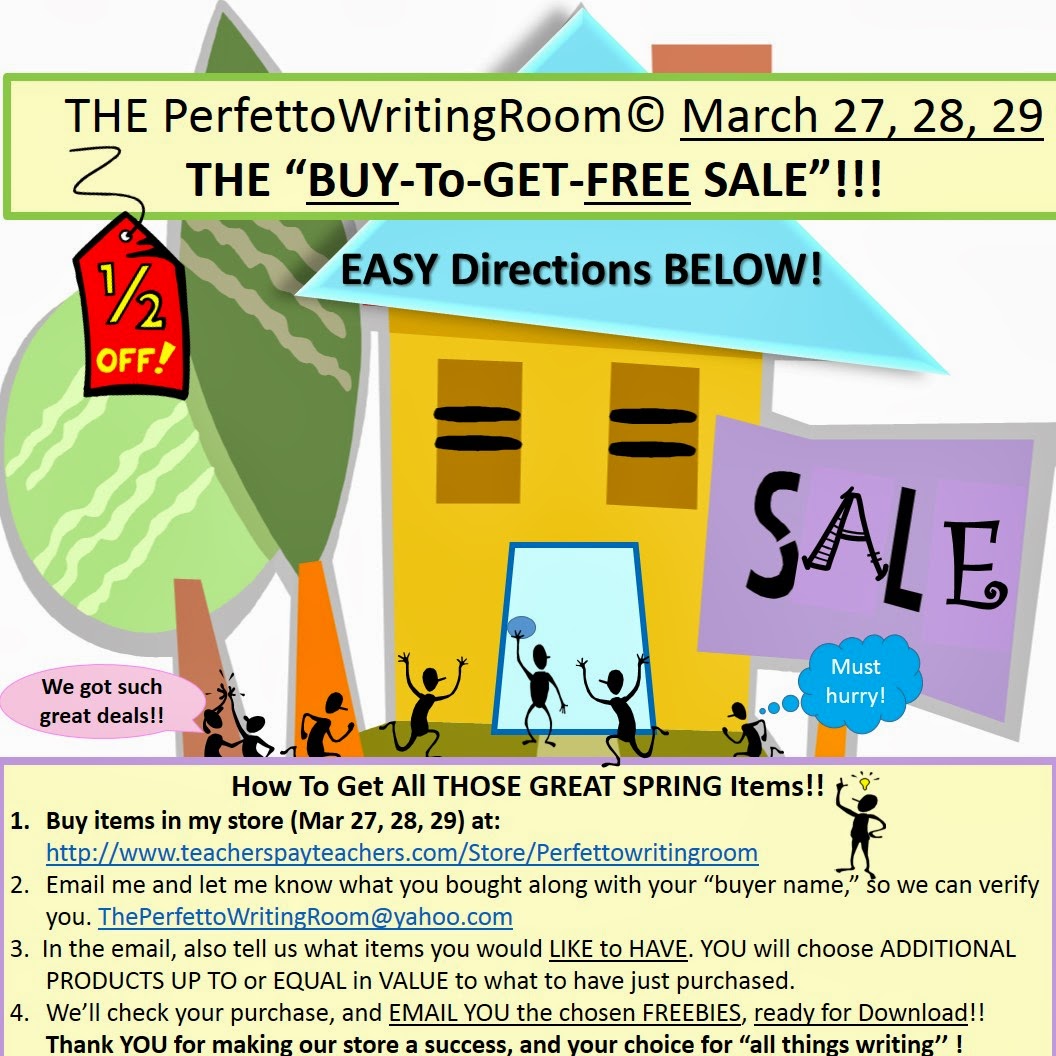
April is Poetry Month. It is also the start of spring, the wending down of the year, and the time you most need to keep students engaged. If you need any writing materials, for yourself or your students... Whatever you buy March 27, 28, and 29, you can get up to the same amount in FREE merchandise. 

THE RULES

1. purchase at The PerfettoWritingRoom Store  March 27, 28, 29
2.Then contact us at ThePerfettoWritingRoom@yahoo.com, and tell us:
 your buyer name, what you bought, AND, what you would like for free!
3. If the items you want are up to or equal in value to your purchased items 
we will send the items to you for immediate download, free
- this is up to a 50% savings overall!!!!


Now that the great news is out of the bag. . .

Here is a question . . . just how many sonnets are there?

Well, this is a troubling topic.
Most folks say two.
I say three.
But then so many people play with form and rhyme scheme, that now it has become rather difficult to actually clarify and teach to students without oversimplifying the matter. Is is fair to oversimplify?

Here are some FACTS: 
1. The "invention" of the sonnet form is credited to Giacomo da Lentini. He lived in the 1300th century. Da Lentini wrote almost 250 sonnets. 

2. Dante Alighieri (1265–1321) was a famous sonnet writer, and a man not only famous for writing the Inferno

                                                                           Dante


    But then there is Petrarch....

3. Francesco Petrarca, better known as Petrarch to the British, elevated the form, using the conventions of courtly love.
4. Petrarch's influence was so strong that the sonnet form is known as the Italian or Petrarchan sonnet, and his reliance on traditional courtly love is now known as the Petrarchan conventions.


The Sonnet Comes to England!!!

                                                      Henry Howard, The Earl of Surrey


                                                                   Sir Thomas Wyatt


5. Sir Thomas Wyatt and Henry Howard Earl of Surrey are credited with introducing the sonnet to England during the 16th century (1500s). It grew quite popular.

6.  During this time, Edmund Spenser, Philip Sidney and his niece Mary Wroth were among the many writers who championed the sonnet form.

7. Wyatt and Howard adjusted the rhyme scheme to account for the differences in the language.

8. The greatest writer of all was William Shakespeare. He wrote over 150 poems, none of them repeating. While he observed the Petrarchan conventions, he pushed against them in his "Fair Youth" and "Dark Lady" sonnet, changing the rules and expanding what a sonnet could be about, for ALL writers present and future. 

                                                 
The Bard Himself
                                   
So How Many Types of Sonnets ARE THERE?
 Not an Easy Question. . . 
9. There is the Italian or Petrarchan sonnet
10. The English or Shakespearean sonnet  
11 The Spenserian sonnet, which is a variation on the Shakespearean sonnet
12. I have learned recently that there are MULTIPLE versions of sonnets, reaching far back, and extending into the present. From the Occitan and Urdu sonnets which I never learned about in school, Dante's version, which a friend of mine just told me about (wonders never cease!), to simple varieties in the standard meter or sonnet sequences as were done by Elizabeth Barrett Browning, it can be challenging to tackle the topic or form or structure in the classroom.
       My advice? Start with history, and Shakespeare is so wonderful, so timeless, that you can never go wrong with studying his work, or by looking at some modern versions and comparing them.
      All of the versions may be discussed in a class environment in a cursory way for enrichment purposes without detracting from your main purpose.It is up to you what that purpose is - whether it be to teach one specific type of sonnet, read for enjoyment, label the parts, or have students write their own version, as long as you and your students grow to appreciate the form....it's all good stuff. 

If anyone wants to start a conversation, add a sonnet type, write a sonnet below...(oh come on you know you want to), or ask a question....DO IT!

Next Post - The Petrarchan conventions, and MORE!

Until then, keep writing, learning, and living well,
Gina @ The PerfettoWritingRoom